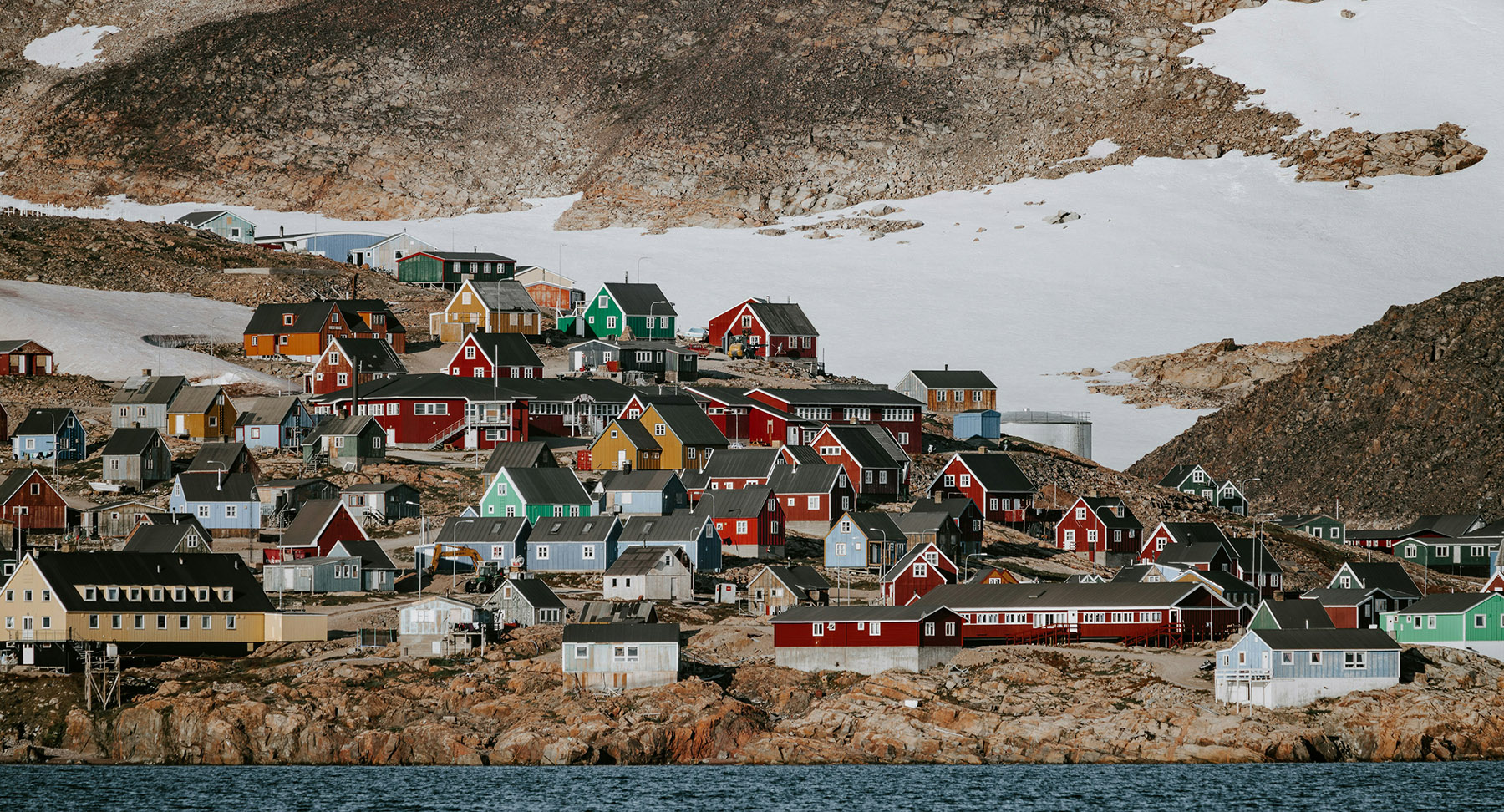
This time, our five questions are addressed to retired colonel Wolfgang Richter. We spoke to the expert on military and security policy at the German Institute for International and Security Affairs (SWP) and Senior Advisor at the AIES about Greenland and the strategic considerations behind the US government’s plan to annex the island.
Mr. Richter, since the defence agreement between Denmark and the USA in 1951, Washington has had numerous military options in Greenland. Furthermore, Greenland is not fundamentally opposed to foreign investors mining raw materials. So what is President Trump specifically concerned about?
The USA has had a troop stationing agreement with Denmark since 1951. During the Cold War, there were up to 17 US facilities on the island. The agreement allows the stationing of up to 10,000 soldiers. The security question could be formally answered by expanding the troop presence. The Americans would therefore not have to acquire Greenland in order to protect it, as President Trump has demanded.
There is therefore much to suggest that the security issue is a pretext, as it could be solved within the framework of NATO-structures. Trump’s goal is much more the restoration of US supremacy in the western hemisphere. This is clear from the security strategy published in November and the latest defense strategy. Both documents give strategic priority to controlling the Western Hemisphere.
The claim to Greenland is therefore ideologically motivated and ties in with Trump’s interpretation of the Monroe Doctrine. Essentially, this means that no other state should exert economic or military influence in the Western Hemisphere. The USA wants to enforce this claim under Trump, if necessary by military means, as demonstrated by the military intervention in Venezuela at the beginning of January showed.
“Trump’s strategy is characterized by contradictions.”
Trump claimed that there was a danger that China and Russia could take control of Greenland. What evidence is there for this?
There is no evidence of this. The former Danish Foreign Minister recently stated clearly in an interview that there are neither political claims by Moscow or Beijing nor a significant increase in Russian or Chinese ship movements in the Greenland region.

With regard to Russia, three aspects are strategically relevant for the USA. In the event of war, NATO would want to prevent the Russian Northern Fleet from breaking through into the Atlantic. The route into the Atlantic runs through the GIUK Gap. This is the sea corridor between Greenland, Iceland and Great Britain. However, NATO is prepared for this scenario and could block this sea route in the event of a conflict.
The other issue is the melting of the ice, which is likely to make the Northwest and Northeast Passages easier to navigate at some point. This will open up new trade routes and raise the question of what control exists over the Northwest Passage under international law. However, it must be borne in mind that once the ice has melted, there will be no land mass left there, but international waters. This raises questions about where exclusive economic zones end under the law of the sea, what claims there are and where they clash. These are long-term regulatory issues. There is no current threat to the USA in this regard.
The third aspect is the missile defense shield planned by the USA. This is intended to intercept intercontinental missiles that pass over the Arctic region and threaten the USA. This defense shield is also to be erected on Greenlandic territory. This brings us back to the first topic we have already discussed: The possibility of setting up something like this in Greenland already exists for the USA, as the stationing agreement with Denmark creates the infrastructural conditions for this. Trump’s strategy is therefore characterized by contradictions. On closer inspection, what remains in the end is an ideologically based claim: to achieve comprehensive control over the western hemisphere, and that includes Greenland.
After a conversation with NATO Secretary General Mark Rutte(-> What makes NATO Secretary General Mark Rutte tick?), Trump’s threats of punitive tariffs against Germany and other EU countries were suddenly off the table. What did Rutte offer President Trump to satisfy him?
When discussing Greenland, Mark Rutte brought up the keyword Cyprus. When Great Britain granted Cyprus independence, it was stipulated by treaty that around three percent of Cypriot territory – including the Akrotiri and Dhekelia military bases – would remain British territory. This was a clear restriction of Cyprus’ sovereignty.
Transferring this model to Greenland would also restrict territorial sovereignty. It therefore seems questionable whether Rutte was well advised to throw this keyword into the discussion. Especially as it would be difficult to explain from a Danish and Greenlandic perspective.

Even if the conflict over Greenland currently seems to have been defused, it could flare up again at any time. What options does the EU have in the event of a possible takeover of the island by the USA?
First of all, it should be noted that Trump declared at the business meeting in Davos that he did not want to use military force against Greenland. At the same time, he has not withdrawn the territorial claim. He is apparently banking on the fact that annexation can be achieved through economic incentives or economic pressure.
Irrespective of this, there remains a considerable loss of trust within NATO. This marks a turning point in transatlantic relations. It remains to be seen whether this trust, which is so necessary for the alliance, can be regained. This means that Europe needs greater strategic autonomy so that it can no longer be blackmailed by the US.
“Greenland is likely to remain closely tied to Denmark for the next ten years.”
Greenland has a large number of important raw materials that are not only important for the USA. The chances of Greenland being ignored by the world powers and left in peace therefore seem slim. How do you see Greenland in ten years’ time?
Predictions are difficult in this volatile international situation. It is possible that the Greenlanders will opt for independence. Probably with close contractual ties to Denmark, on which the island is financially dependent, among other things. Around half of Greenland’s national budget is covered by Danish subsidies. If Greenland is faced with the choice of joining the USA or Denmark, the tendency is clear: it will not be the USA.
Greenland is therefore likely to remain closely tied to Denmark for the next ten years. However, possibly with extended autonomy. It remains to be seen whether the USA will refrain from exerting further military, economic or hybrid pressure to change this situation.
At the same time, it is to be expected that NATO will not only try to strengthen security in the far north symbolically, but also with substantial military measures.
Click here to the other articles in our series “5 questions to”.