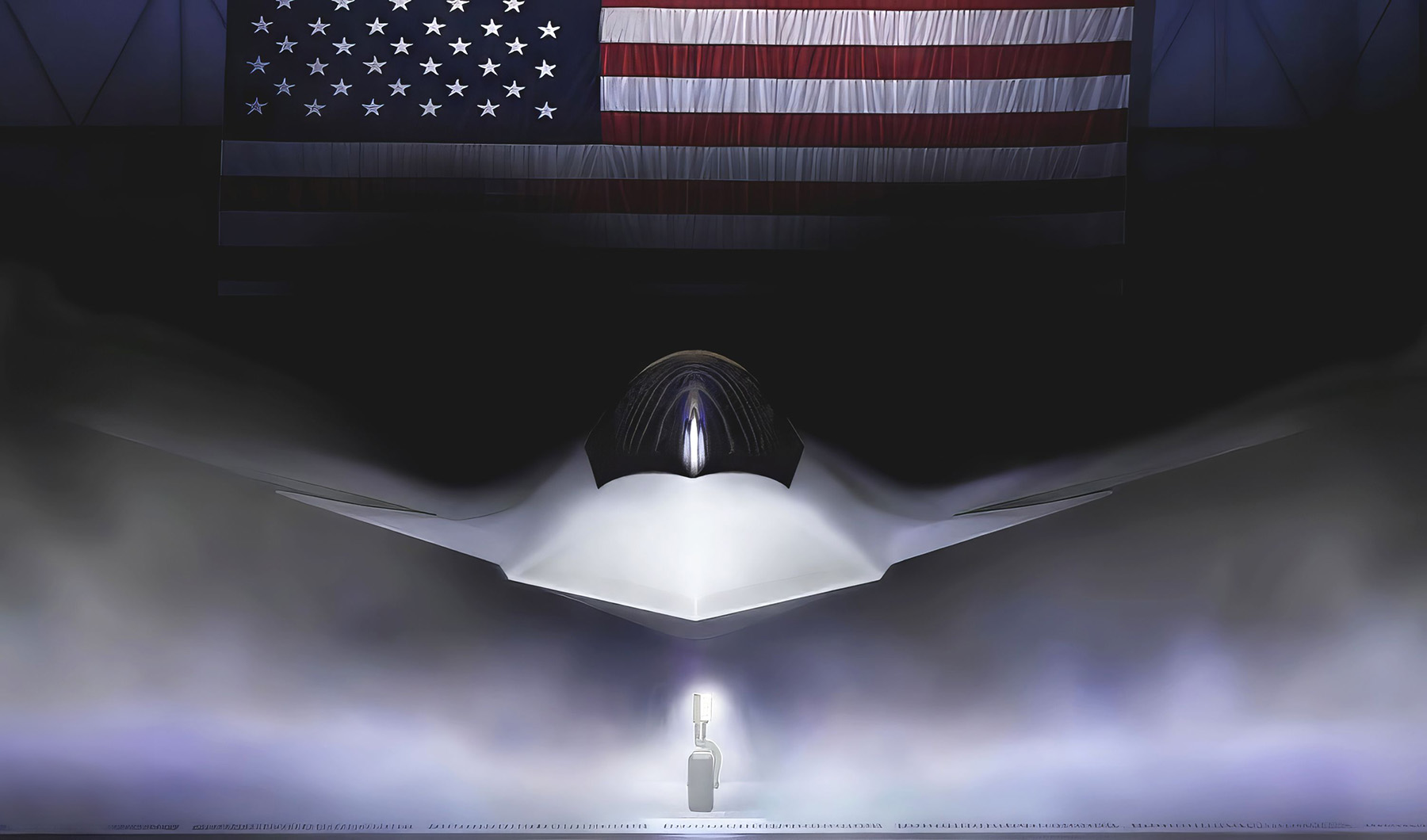
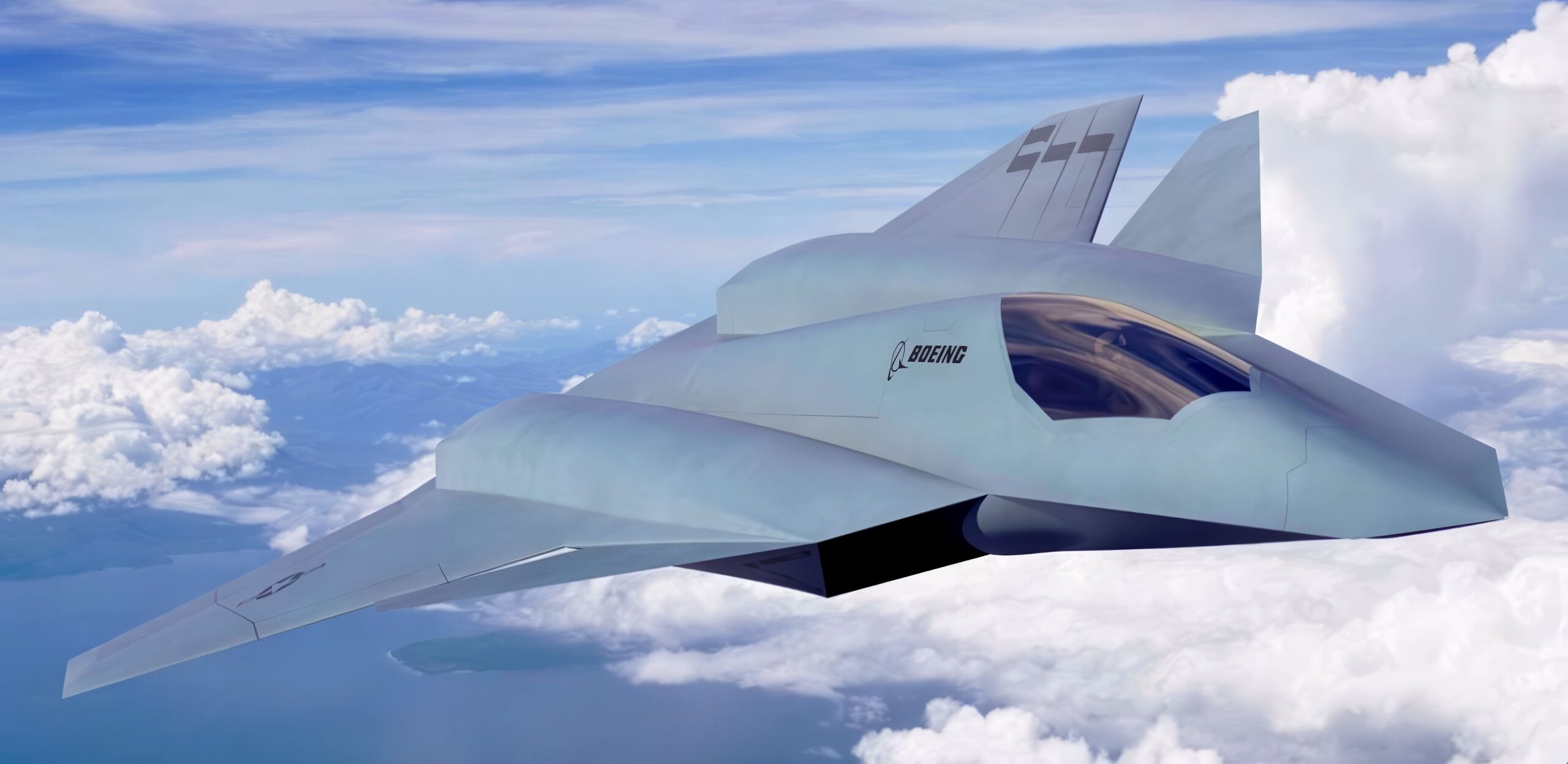
Shortly after the pompous announcement in the Oval Office – including superlatives by the US President – the Boeing-award for the NGAD program has now been confirmed by new, higher-quality graphics and an official statement from the US Air Force (-> current news about the US armed forces) make it much more tangible. The first in-depth conclusions can be drawn. And first of all: the aircraft designated as the F-47 is likely to be smaller than previously assumed.

Clearly recognizable Boeing DNA
The two airbrush graphics presented on March 21 – displayed on easels as part of the official announcement – make an immediate visual connection for anyone who has been involved with stealth aircraft for years: The design bears unmistakable traits of an early Boeing stealth technology demonstrator, the “Bird of Prey”. Named after the Klingon cruiser from Star Trek, the experimental aircraft was developed in the late 1990s – a kind of legacy from Boeing’s acquisition of McDonnell Douglas in 1997.
The frontal view in particular, with its flat, broad fuselage and characteristic nose section, is strikingly reminiscent of the original design. The Bird of Prey flew a total of 38 times between 1996 and 1999 under the designation YF-118G before it was officially unveiled in 2002 and handed over to the USAF Museum in Dayton, Ohio, where it is still on display (or more precisely, hanging) today.

The compact stealth aircraft is said to have a radar cross-section that was so small that it was visible to the naked eye but could not be detected by the radar of modern fighter aircraft at the time – even from a few miles away. According to the accompanying text in the museum, its RCS value was even lower than that of today’s F-22 – and that with stealth technology that was over 30 years old. The Bird of Prey is therefore regarded as a technical pioneer and source of inspiration for later – and, as is now apparent, future – stealth designs.
The nose …
… is significantly more massive in width, diameter and cross-section than anything previously seen on fighter aircraft – with the exception of bombers. At first glance, such a design does not correspond to the classic specifications for an optimized radar cross-section for stealth aircraft. But the conspicuous size suggests something else: space for sensors – and plenty of it.
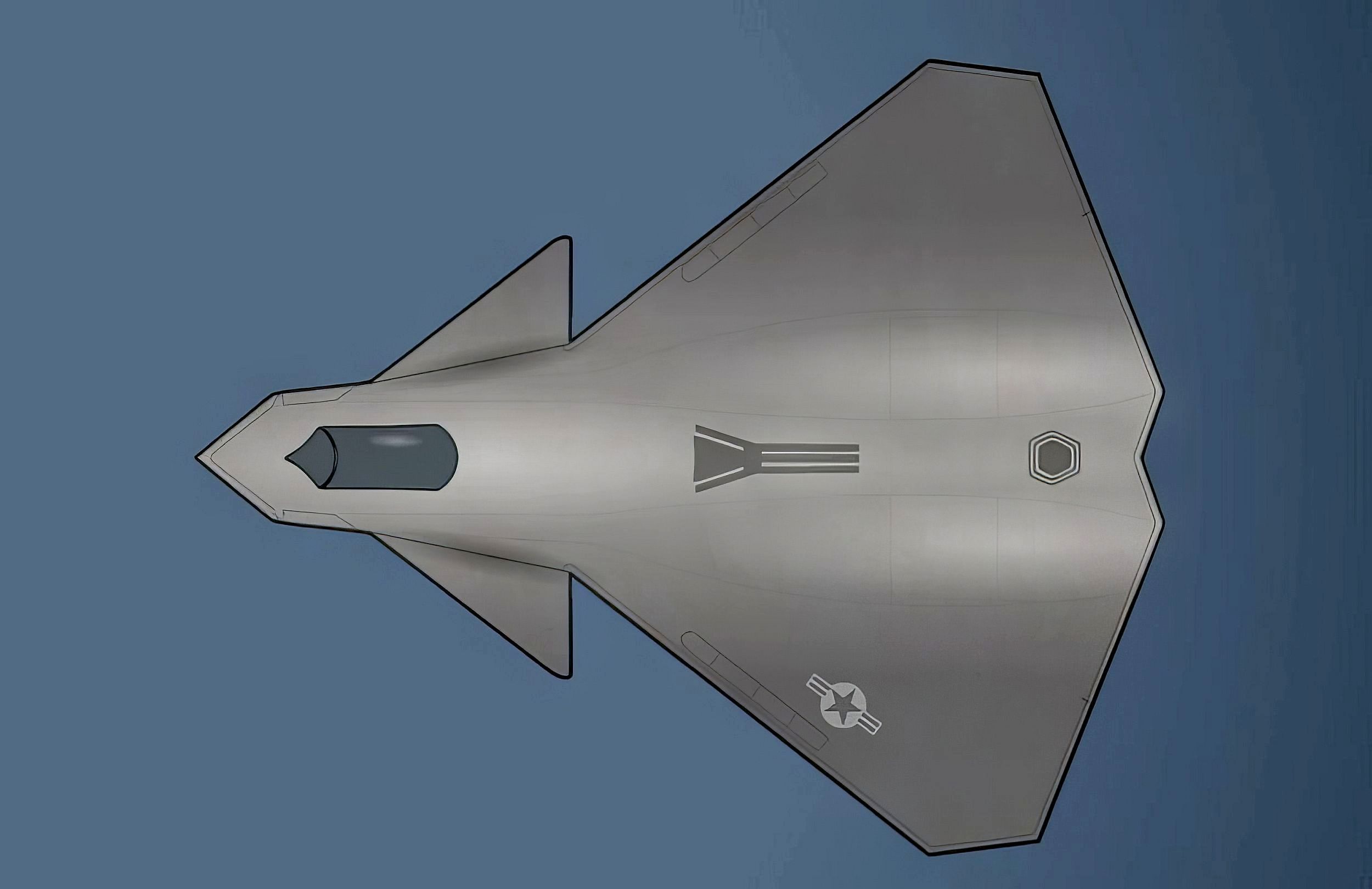
With modern or future AESA radars, which are based on gallium nitride technology and partly AI-supported, completely new performance dimensions can be achieved with such a generous volume. Range, resolution, target tracking – with this “sensor nose”, the F-47 should be able to see a lot. It is also conceivable that the entire nose section – possibly as a dielectric fairing – could itself function as a radar. In the final version, other external surfaces could even be integrated into this function.
Another exciting aspect of the exterior design: the new images clearly indicate canard slats – and not too small, with a positive V-position (pointing upwards). This is remarkable, as canards are considered rather problematic from a stealth perspective. However, their integration could have something to do with another Boeing involvement: the parallel F/A-XX project for the US Navy, where a decision is also expected this year. For the carrier-based fighter jet, additional lift aids – such as canards – would be entirely plausible.
However, the main wings of the F-47 also have a positive V-shape in the front view, similar to the Bird of Prey around 25 years ago. The Boeing DNA is therefore not only noticeable in the silhouette, but also in the aerodynamic details.
Next-generation engine
As expected, no mention was made of the F-47’s engine in the Oval Office. However, it is almost certain that the aircraft will be equipped with an engine from the Adaptive Engine Transition Program (AETP) – the US development program for next-generation propulsion systems. Both General Electric (XA100/XA102) and Pratt & Whitney (XA103) have brought adaptive engines to test maturity in recent years. For the F-35 Block 4 from Lockheed Martin they were ready for series production too late – for the NGAD, on the other hand, they should be a given.
The special feature: In principle, these engines generate a third airflow – or rather, a variable second bypass flow – which can be switched on during cruise flight. The result is a significant increase in efficiency, i.e. more range with the same fuel consumption – a decisive advantage with regard to Pacific scenarios with wide deployment radii.

At the same time, this additional airflow could be used to cool the increasingly energy-intensive on-board electronics. This is because conventional air inlets for cooling can hardly be integrated for stealth reasons. The variable bypass is deactivated when required – for example when approaching a target quickly or to take evasive action: The engine then operates again like a classic turbojet with maximum thrust. Or, as a technologist once put it: “A turbofan for the journey – a turbojet for the fight.”
In size rather F-22 than J-36
This combination of thrust and efficiency could explain why the F-47 is surprisingly compact – at least compared to other 6th generation designs. European concepts such as GCAP (-> GCAP project on track) and FCAS, or China’s tri-jet stealth jet (-> Will China win the race for the 6th generation fighter jet?) appear to be real giants in comparison, with wingspans of over 20 meters in some cases and lengths of up to 30 meters.
The F-47, on the other hand, is likely to be closer in size to the F-22 – or even smaller. An interesting indication of this can be found in a small detail on the rendering in the Oval Office: the nose landing gear is single-wheeled and extremely compact. Even President Trump made a joking comment about it. In contrast to the elaborately multi-wheeled nose landing gear of the Chinese J-36, this rather speaks against a heavy aircraft.
Just a few years ago, there were many indications that the US Air Force preferred a larger, heavier platform concept for the NGAD. However, at the latest since Will Roper, then head of armaments procurement at the USAF, publicly spoke of a smaller, F-35-sized design in 2020, the picture has shifted. And this may now have become a reality – at least if the latest graphics are to be believed.
Range instead of size – a system approach
In the meantime, the US Air Force had even considered an alternative concept: What if, instead of a large fighter jet, they preferred to have a large stealth tanker? The idea: such a tanker – as part of the planned “Next-Generation Air Refueling System” (NGAS, -> Jetzero and Northrop Grumman are building mega-transport-and-tank-only aircraft) – could operate deep in contested airspace and thus provide fuel on a regular basis. As a result, the NGAD jet itself would have to carry less fuel and could be built smaller. A return flight to base would not be absolutely necessary – a short refueling at the stealth tanker would suffice.
However, these considerations were rejected. The Air Force command ultimately came to the conclusion that such an NGAS was technically feasible, but too expensive and – despite the camouflage – still a vulnerable “force multiplier”. The idea disappeared into a drawer.
A smaller jet with a larger operating radius?
At the same time, the current Air Force Chief of Staff, General David Allvin, made it clear that the F-47 would have a significantly larger operational radius than today’s 5th generation jets – despite its more compact design. But how is this supposed to work when even the operational radius of modern stealth jets such as the F-22 or F-35 is only 600 to 900 kilometers?
The answer starts with the engine: the manufacturers of the adaptive drives – GE (XA102) and Pratt & Whitney (XA103) – are talking about at least 25 percent less fuel consumption and higher performance at the same time. That alone would significantly increase the range.
But there is more to it than that: The structure of the F-47 could be designed to have a limited lifespan rather than decades of operation. The idea dates back to the time of Will Roper, then head of procurement in the Trump I era. He focused on iterative, rapidly renewable designs instead of overpriced individual developments that were dragged out over decades. The result: more aircraft at significantly lower unit costs – instead of a development stop in 2024 due to feared unit costs of almost 300 million euros per jet.
Efficiency through teaming and reduced weapon package
Another factor is that the F-47 is designed from the ground up for man-machine teaming. Supported by up to five collaborative drones – presumably under the designations FQ-42A and FQ-44A – the manned jet itself may not need to carry many weapons. Two to four AMRAAM-sized guided missiles (presumably AIM-260) could be enough – the wingmen drones take care of the rest.

This means smaller weapon bays, less weight – and therefore more space for internal fuel. Together with new manufacturing techniques such as 3D metal printing, AI-optimized structural planning and the possible use of only one adaptive engine in certain mission profiles, this results in a scenario in which the F-47 could achieve up to 50 percent more operational radius than an F-35.
Already during Trump’s term in office …
As General Allvin recently confirmed, several NGAD demonstrators have flown in the past five years. several NGAD demonstrators have flown – allegedly hundreds of times without it becoming public knowledge. Back in 2020, Will Roper, then head of procurement at the USAF, provided the first indications and spoke of “many records”. It is therefore considered certain that there was at least one demonstrator financed by the DARPA-affiliated Aerospace Projects Office (APO) – probably as part of the so-called Aerospace Innovation Initiative.
At the same time, there were operational prototypes from the two competing companies – similar to the YF-22/YF-23 demonstrators more than 30 years ago. This means that the USA is by no means lagging behind China, even if the sightings of Chinese prototypes on December 26 caused an international stir. On the contrary – the F-47 has apparently already reached a high level of technical maturity. Allvin even promised that a near-production prototype from Boeing’s “Phantom Works” would be flying during President Trump’s second term – i.e. by 2028 at the latest.
This will be followed by a phase of intensive testing and refinement, but the timetable seems ambitious but realistic: the first production aircraft could be delivered to the USAF from 2032, with initial operational capability (IOC) around 2035. The European GCAP and FCAS projects should also be flying by then – as should the Chinese J-36 and J-50 with final mission equipment.
Two remarkable details at the end
On the one hand: The NGAD order is historic for Boeing. It is the first fighter aircraft order of its own in the jet age. All previous types – such as the F-15, F/A-18 and AV-8B – were acquired with the takeover of McDonnell Douglas in 1997.
And secondly, the stock market reacted promptly. Immediately after the announcement of the billion-euro contract award, Boeing’s share price rose by 5 percent – a clear sign of confidence, despite the series of breakdowns in recent years and the replacement of Ted Colbert as head of the defense and aerospace division in autumn 2024. Lockheed Martin, the losing bidder and the world’s largest defence company, on the other hand, saw its share price fall by around 6 percent – but is likely to be reintegrated into the project as a subcontractor in the medium term.
Boeing is now set to massively expand its production in St. Louis, Missouri. The NGAD will be produced in a new plant expansion already under construction in the north of the city – close to Lambert International Airport, with an investment volume of around 1.7 billion euros. Hundreds of suppliers and highly skilled jobs are part of the project – a boost for Boeing’s comeback in the defense sector.
A final side blow from the President
In a remark that is probably also to be understood as a reaction to the growing skepticism of some US partners in matters of supply security, President Trump said at the presentation of the NGAD on March 21: “Our allies keep calling – they want to buy it too. And to certain allies, we may sell them watered-down versions. We’ll ‘tone it down’ by about ten percent. Which probably makes sense – because maybe one day they won’t be our allies anymore.”
Whether the F-47 will ever actually be exported is written in the stars. But the message was clear.
Here for more news about Boeing and here for more news about the US armed forces.