If any of our readers are in the USA over the next two months – and have a soft spot for “aviation archaeology” or recent aviation history – here’s a special tip: an icon of the Cold War, but only on public display until March 7.
It is one of the strongest symbols of the military secrecy of the Soviet era as well as of the Western perception of Soviet high technology: the former Iraqi MiG-25RB Foxbat-B, a reconnaissance version with the serial number 020657, which was unearthed in Iraq in 2003. The aircraft is currently on temporary display in the “Cold War Gallery” of the National Museum of the US Air Force (NMUSAF) at Wright-Patterson Air Force Base in Dayton, Ohio.
There, the Foxbat is located in a prominent neighborhood: not far from the F-117 Nighthawk (first mission Panama, December 20, 1989), flanked by Su-27, MiG-29, A-10, F-15C, Tornado and other icons of that era. The MiG-25 still holds a special record to this day: 37,560 meters altitude in 1977 – a value still unattained today for a manned jet aircraft.


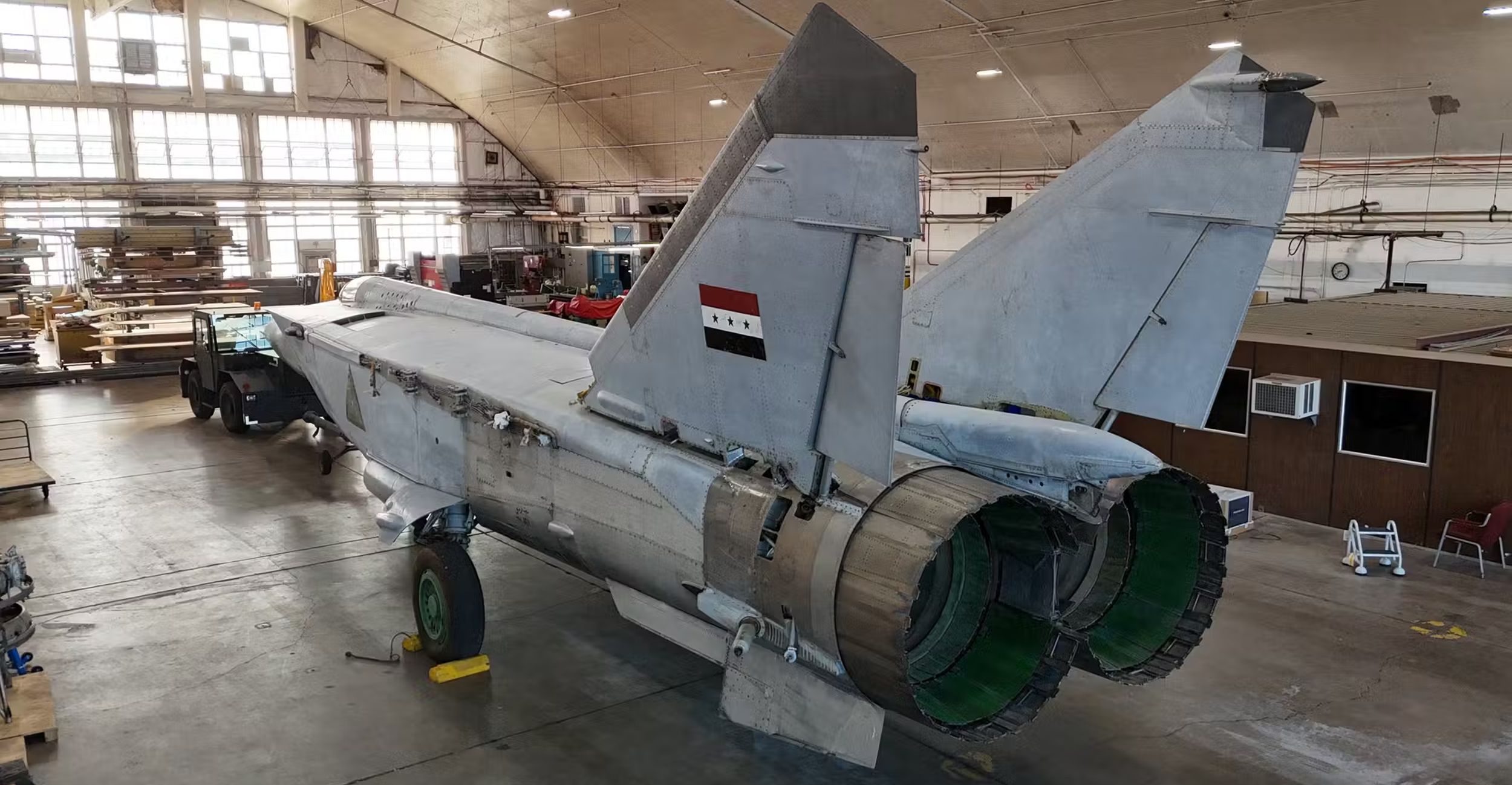


Recovered without wings
The museum received the aircraft in 2006, after it had already been discovered by US troops in 2003, during the first months of the US-led ground offensive as part of “Operation Iraqi Freedom”. Near the Al Taqaddum airbase in central Iraq – around 240 kilometers west of Baghdad – the MiG was literally buried in the sand.
When the Foxbat was uncovered in July 2003, it was found to be incomplete: the wings were missing and could not be found later. Nevertheless, the fuselage was salvaged and finally transferred to Wright-Patterson AFB on a C-5 Galaxy, where it was examined in detail.
The Foxbat-B was one of the few survivors of the original Iraqi fleet of around 35 MiG-25s. The majority of these Mach 3-capable aircraft had already been destroyed during Operation Desert Storm – mostly on the ground, but two in air-to-air battles.
Conversely, the MiG-25 also scored a prominent aerial victory: on the first night of “Desert Storm”, 17 January 1991, Iraqi pilot Lieutenant Zuhair Dawoud managed to bring his MiG-25PDS behind a US formation using ground-based GCI guidance and, using an R-40RD long-range missile, to destroy the F/A-18C of USN Lieutenant Commander Scott Speicher to be shot down. A US Predator drone was also shot down by a MiG-25 in 2002.
Unattainable heights
However, the museum piece now on display was an unarmed reconnaissance aircraft, recognizable by the camera windows in the bow – although the designation RB (in contrast to the pure R version) also permitted the use of bombs.
Iraq began procuring high-performance Soviet reconnaissance aircraft back in the 1970s. The MiG-25RB was ideal for strategic reconnaissance: Iranian air defence, troop movements and the US presence in the Persian Gulf could be monitored relatively unhindered thanks to speeds of around 3,000 km/h and operational altitudes of over 22,000 meters.
The Foxbat played a central role in the First Gulf War (1980 to 1988) in particular. Equipped with A-70M or A-72 high-resolution cameras with focal lengths of between 650 and 1,300 millimetres and a resolution of one to two meters, it provided the Iraqi military with valuable strategic information.
In 2003, on the other hand, Allied air superiority was so overwhelming that the remaining aircraft were either hidden or – as in the case of 020657 – buried in the desert sands to avoid destruction or looting.

More symbolism than effect
Will McLaughlin, curator of the USAF Museum, explained the significance of the temporary exhibition: “The MiG-25 is interesting not only as an enemy fighter aircraft, but because of the fear and respect it inspired in the US defense establishment in the late 1960s. Technical speculation and spy photos sent warning signals through Western Cold War air forces. The huge air intakes hinted at capabilities that could far surpass the standard F-4 Phantom II at the time – and ultimately motivated the development of one of the most successful US fighter aircraft: the McDonnell Douglas F-15.”
However, this fear was put into perspective when Viktor Belenko deserted to Japan with a MiG-25P in 1976. The aircraft was mainly made of steel instead of titanium, and the avionics were largely based on vacuum tubes – robust, but technologically backward. The engines were able to reach Mach 2.8 to 3 for a short time, but only under extreme material stress. Maneuverability was also extremely limited at all altitudes.

A total of 1,186 MiG-25s were built between 1970 and 1984. Egyptian aircraft flew over Israel, in the GDR Foxbats were stationed in Finow and Werneuchen from 1974 to 1990. The last MiG-25s flew in India until 2006 (Squadron “Trisonics”) and in Algeria until 2022.
The further development MiG-31BM Foxhound is still active on the Russian side today – among other things as a carrier of the Kinschal hypersonic missile in the war against Ukraine.