Rheinmetall has been commissioned by the Bundeswehr Procurement Office to develop a key component for a future laser weapon system. At the end of the second quarter, the Federal Office of Bundeswehr Equipment, Information Technology and In-Service Support (BAAINBw) signed a contract with Rheinmetall Waffe Munition GmbH for the manufacture of a laser source demonstrator, which, according to official information, has a volume “in the lower double-digit million euro range”.
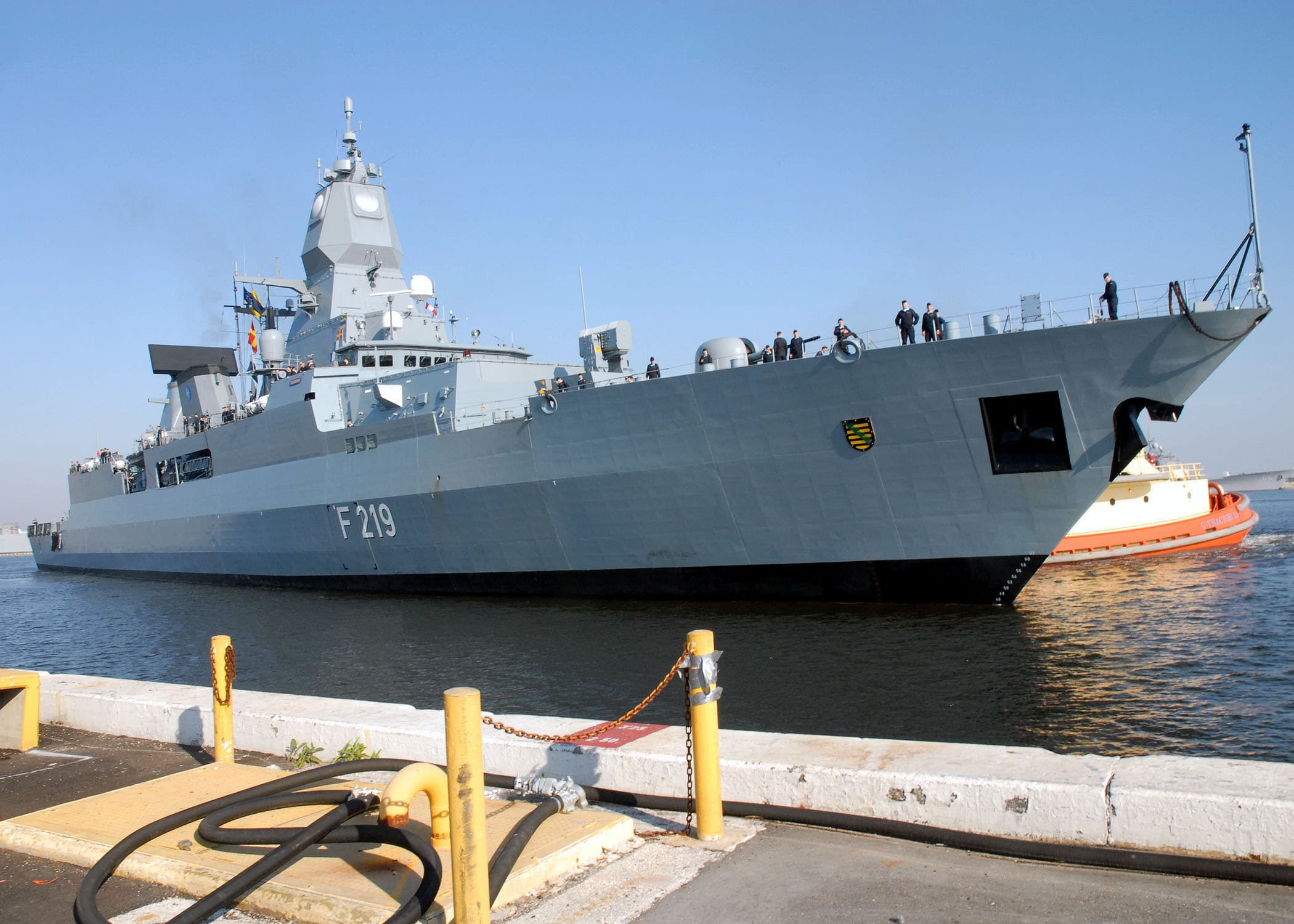
The laser source demonstrator can be used cross-sectionally in various projects to investigate laser source technology for military applications in greater depth. As the first project, the laser source demonstrator will be used for a one-year test phase on the German Navy’s Sachsen frigate. The laser source demonstrator is based on spectral coupling technology, which has been the subject of intensive research at Rheinmetall for many years. Key data of the demonstrator are a scalable output power of up to 20 kW with very good beam quality. At its core, the demonstrator consists of twelve almost identical 2 kW fiber laser modules with almost diffraction-limited beam quality. The twelve fiber laser modules are coupled via a beam combiner, an assembly for combining the beams of several laser sources into an overall beam based on dielectric grating technology, to form a laser beam with very good beam quality. Spectral coupling technology has a number of advantages over other coupling technologies, such as geometric coupling: low complexity, high modularity, potential for growth into the 100 kW laser power class and the ability to operate as a passive system with extremely low control requirements. In 2015, Rheinmetall successfully deployed a functional model of a laser weapon system from on board a ship against targets on land for the first time in Europe during a test campaign in the Baltic Sea. In 2018, BAAINBw and Rheinmetall successfully tested a laboratory sample of a 20 kW laser source. The planned trials in a military environment and under near-operational environmental conditions are therefore the next step on the way from the laboratory to the field – and this within just three years. This is a major, necessary and challenging step towards the introduction of future laser weapon systems.
Click here for further reports on Rheinmetall.