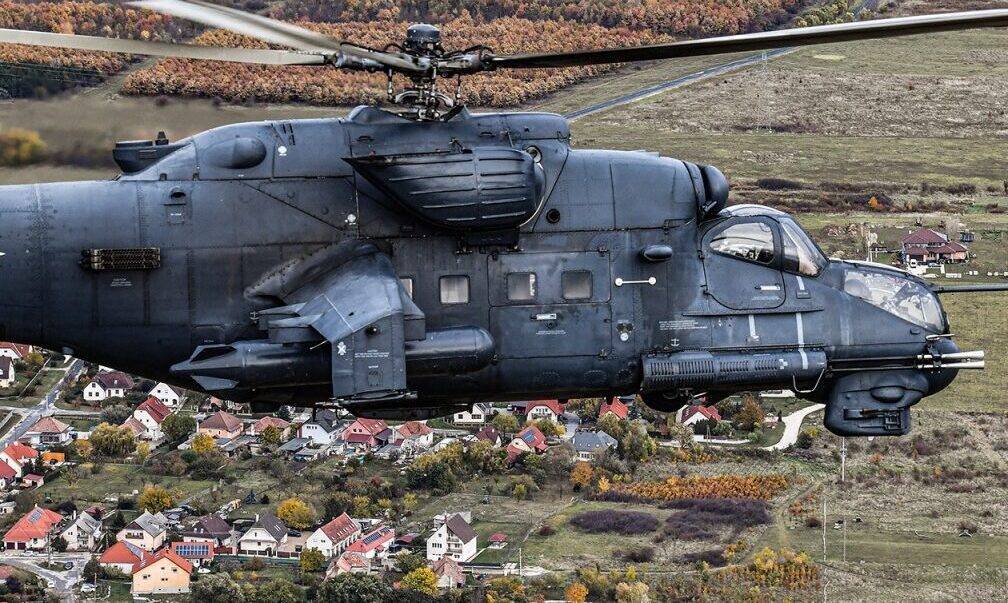
The Hungarian armed forces are retiring their Mil Mi-24 P/V combat helicopters now that the last examples have also exceeded their planned, already extended service life. The Mi-24 P/V with the identification 334 completed its last live firing at the end of October 2025. At the beginning of 2026, an almost 50-year era came to an end: the last Mi-24s were decommissioned.
For decades, the Mil Mi-24 was considered one of the best-known combat helicopters. Equipped with two shaft turbines, the “flying tank” – as the Mi-24 was called by the Soviets – reaches a top speed of 335 kilometers per hour and a flight altitude of 4,500 meters. The permissible payload is 1,500 kilograms internally and 2,400 kilograms externally. Another interesting and rather unusual feature for combat helicopters is the fact that up to eight soldiers can be transported in the cargo hold.

Historical review: Hungary builds up its Mi-24 fleet
The first four aircraft of the Hungarian People’s Army (Magyar Néphadsereg) landed at Szentkirályszabadja airfield, not far from the Balaton, in the summer of 1978. The training of the Hungarians was supported by a Soviet flight instructor and a Soviet gunnery operator. Not only did they diligently complete inspection flights, they also practiced fire support and anti-tank procedures. The new combat helicopter squadron demonstrated its skills for the first time at the Warsaw Pact’s “Shield 79” (“Pajzs 79”) military exercise. In the meantime, more and more helicopters arrived, so that a further squadron was set up in September 1980.
Österreichs Hubschrauberpiloten trainieren wieder im Hochgebirge
This meant that Hungary already had three transport helicopter squadrons and two Mi-24 squadrons. Initially, the then People’s Army procured Mi-24D version aircraft. From 1985, the new Mi-24V version was ordered as part of the “Mátra” armament and modernization programme, which brought with it several innovations in terms of both flight and weaponry. The high point was in 1989: A total of around 70 helicopters were in Hungarian service, including 39 Mi-24 combat helicopters. When the Mi-24V was ordered, the initial intention was even to set up a third combat helicopter squadron. However, this plan was not implemented for personnel and financial reasons.
From the wars in Yugoslavia to the mission in Afghanistan
After the fall of the Iron Curtain, there was a significant deterioration in operational capabilities. Due to the permanent shortage of spare parts, both the number of operational helicopters and the number of flight hours to be completed each year fell continuously. The takeover of a total of 20 aircraft – including 14 Mi-24Ds and six Mi-24Ps – from the National People’s Army (GDR) did little to change this.
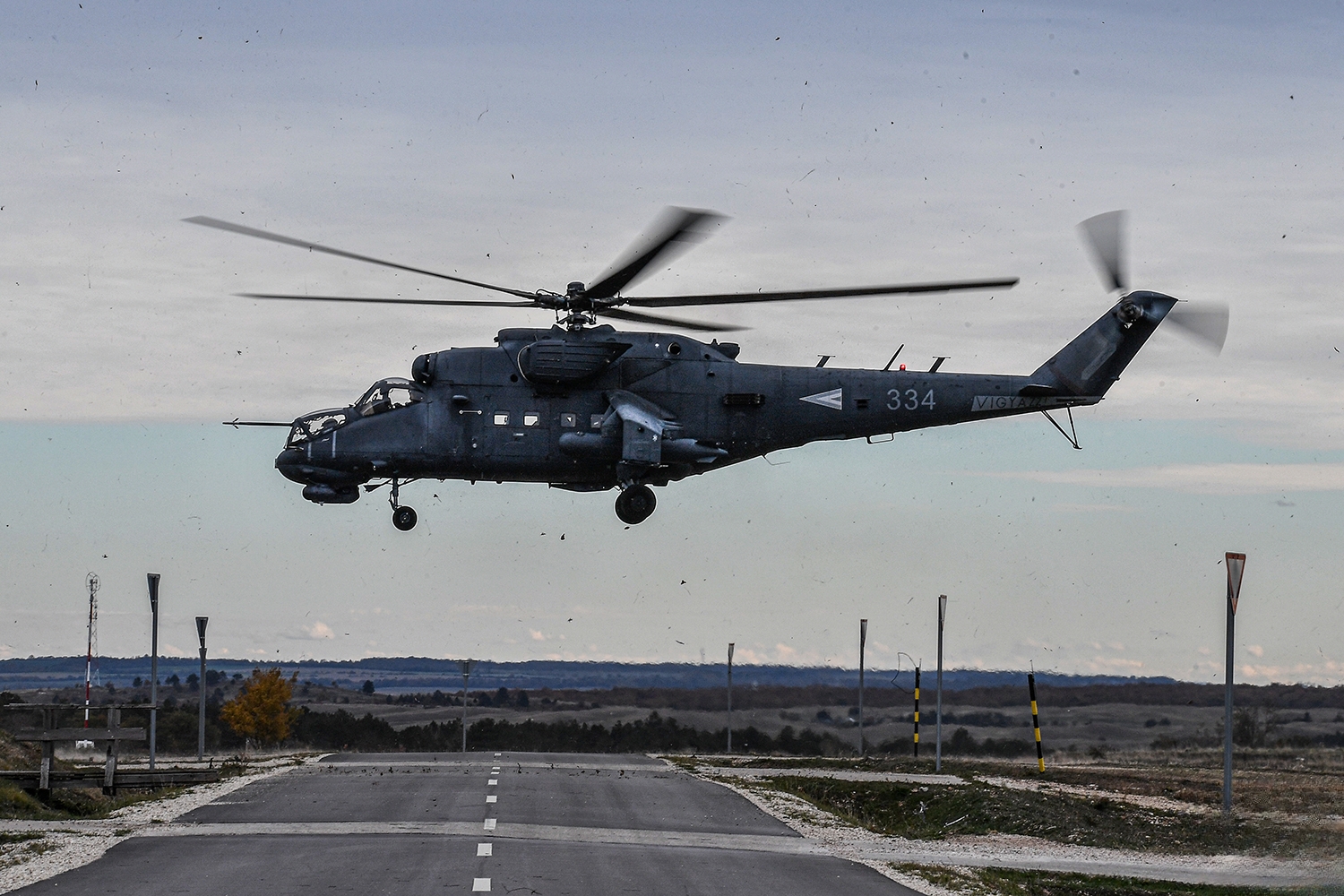
In the course of the Yugoslav Wars, the Mi-24s were alerted and deployed to Taszár and later to Kecskemét to help secure the southern border. The combat helicopters took on a similar task in 1999 in connection with the Kosovo war. 2003 saw the closure of the Szentkirályszabadja airbase and the actual agony of the Mi-24 fleet. In the course of the subsequent reorganization, the two helicopter squadrons were disbanded and integrated into the 86th Helicopter Regiment Szolnok. The unit stationed in Szolnok was given the designation Combat Helicopter Battalion.
At the NATO-mission in Afghanistan (-> Afghanistan, where are you going?), Hungarian Mi-24 combat helicopter pilots and technicians took part as part of the Air Mentor Team (HDF Mi-35 Air Mentor Team). The first contingent arrived in Kabul in April 2010. Their mission was to train and support the Afghan helicopter crews (Mi-35) and technicians in accordance with NATO standards. In addition to the flights, the Hungarian soldiers also held theoretical training courses for their Afghan colleagues and set up a computer-equipped preparation and training room together with the US mentors. The last Hungarian contingent completed its mission in 2013.
Eurofighter und NETMA entwickeln Aerodynamic Modification Kit (AMK)
The end of the Mi-24 combat helicopters in Hungary
In 2017, the Hungarian government signed a contract for the general overhaul of eight plus four helicopters. The transportation of the selected aircraft from Hungary to St. Petersburg on an Antonov An-124 Ruslan began at almost the same time as the contract was signed. The contractor had ten months to carry out the overhaul work from the time of takeover.
Although the original plans envisaged the modernization of a total of twelve helicopters, only two Mi-24Vs (711 and 720) and six Mi-24Ps (335, 336, 358, 361, 415 and 444) had been transferred by August 2018, leaving the Mi-24 fleet at eight aircraft at the beginning of the 2020s. The era of Soviet combat helicopters in Hungary came to an end when the last aircraft was retired at the beginning of 2026.
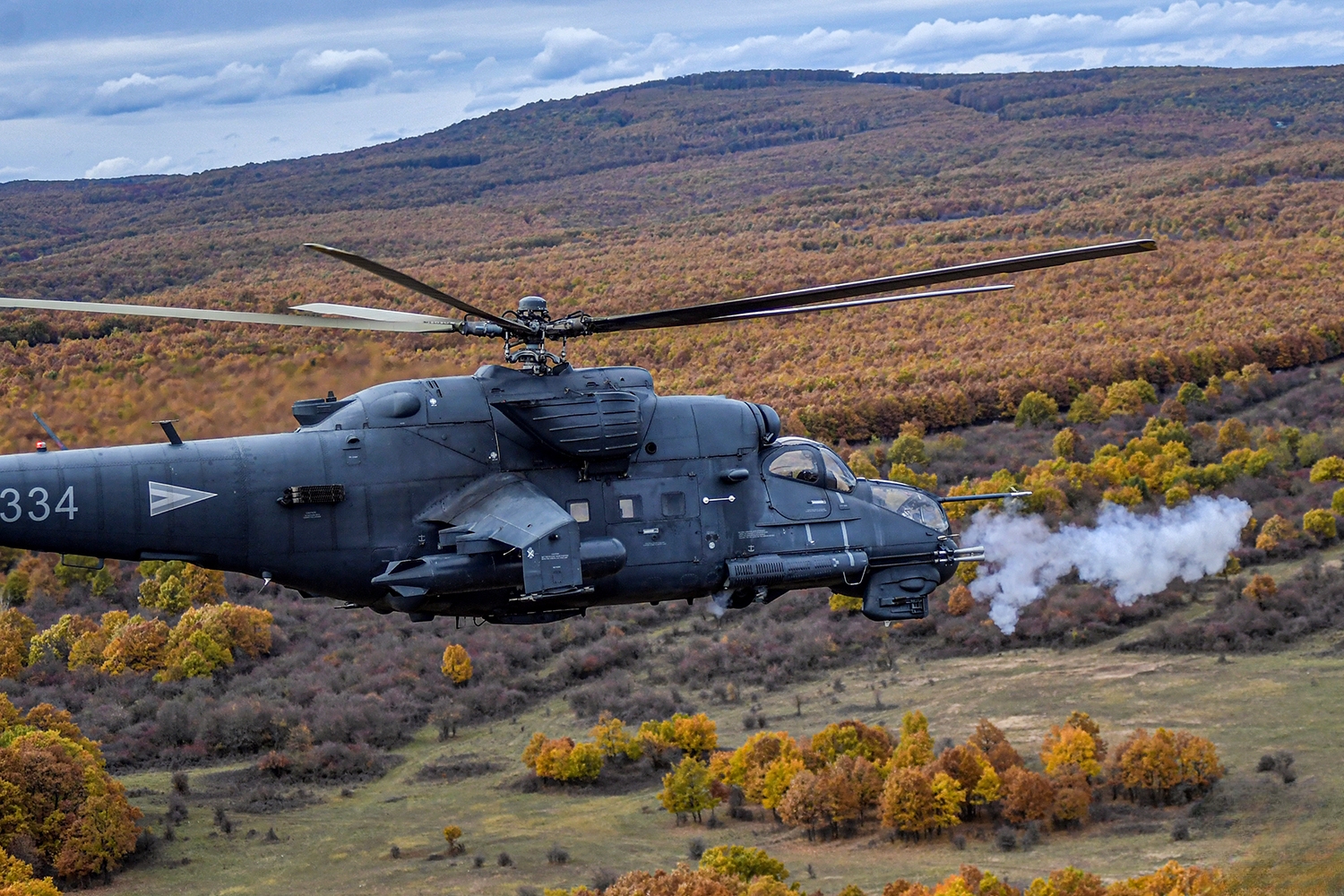
In future, some of the Mi-24’s tasks will be taken over by the light H145M helicopters, which can be equipped with additional weapon modules. However, this can only be an interim solution, as the light H145Ms are less suitable for traditional use as combat helicopters. According to Italian media reports, a Hungarian delegation held talks at the beginning of 2023 about the procurement of the Italian AW249 combat helicopter from the manufacturer Leonardo. In September 2023, General László Tömböl also visited the factory where the AW249 is produced. No further details are known to date.
Here for more news about the Hungarian armed forces.