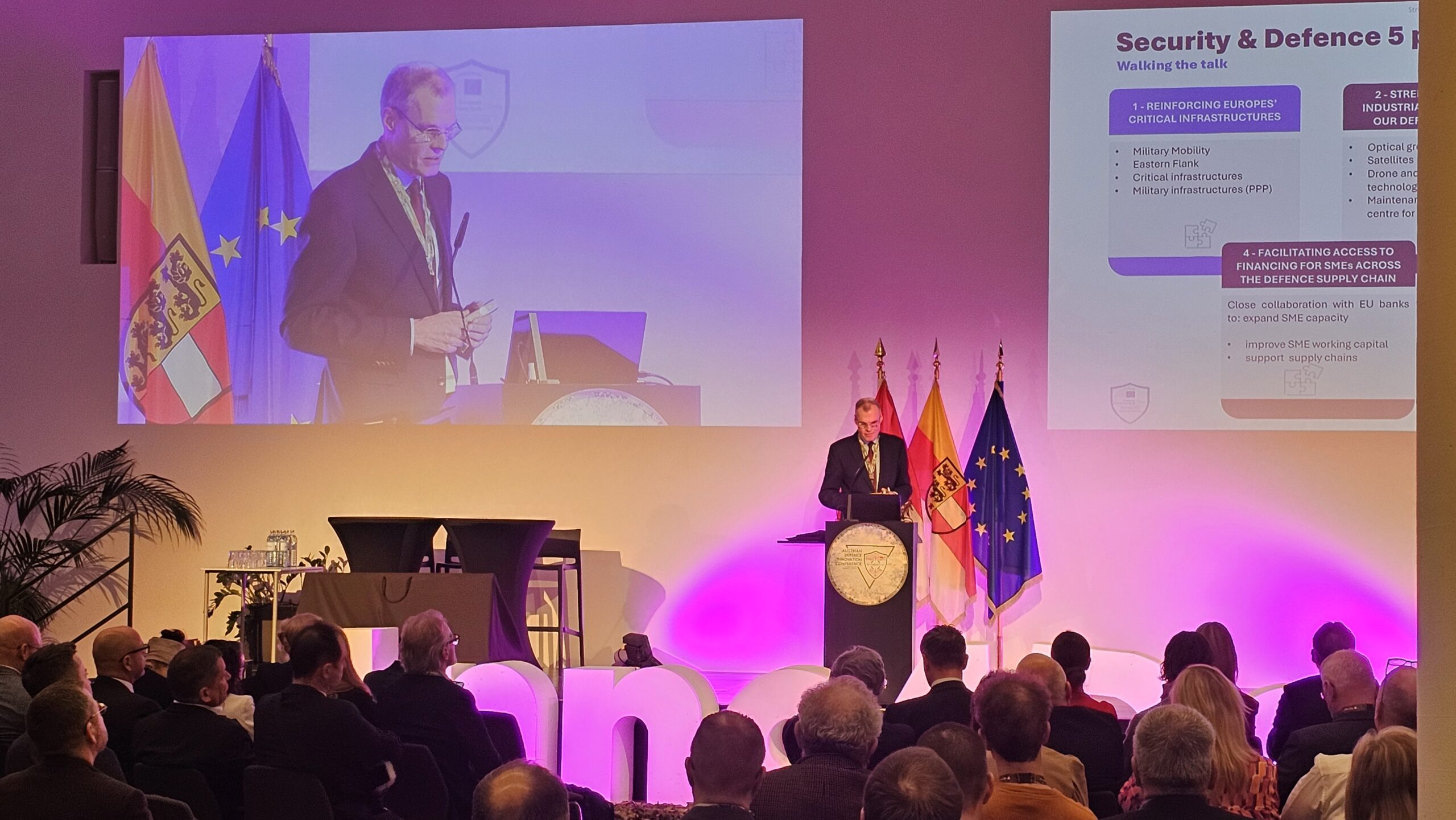
The European Investment Bank (EIB) is still insufficiently known to many players in the security and defense policy environment. Yet it has long played a key role in financing strategically relevant investments in Europe. Gunnar Münt, Senior Advisor at the EIB, pointed this out in his presentation at the Austrian Innovation Defense Conference impressively.
The EIB is the investment bank of the European Union and is owned by all 27 EU member states, which have provided it with equity capital – including Austria. On this basis, the bank raises funds on the international capital markets. Thanks to its first-class AAA rating, it can refinance itself there at extremely favorable conditions and pass on these financing advantages directly to its borrowers.
Last year alone, according to Münt, the EIB granted new financing amounting to almost 100 billion euros. Around 90 percent of this was for projects within the EU and around ten percent for projects outside Europe. The bank is strictly investment-driven: It only finances real assets such as infrastructure, production facilities or research and development projects – no current expenditure or operating costs.
Gradual opening for security and defense
For a long time, the defense sector was completely excluded from the EIB. Until 2014, neither defense, police nor internal security areas were allowed to be financed. Only after the Russian annexation of Crimea (-> Latest news from the war in Ukraine) did the then EIB President Werner Hoyer initiate a rethink. An internal working group systematically addressed the issue of defense for the first time – a process that took several years.
In 2017, the EIB’s Board of Directors finally decided to allow financing in the dual-use sector. The prerequisite at the time was that both sales and investments had to come predominantly from civilian applications. Under this restrictive framework, projects in the aerospace sector were initially made possible that had military relevance but were clearly civilian in nature.
This framework was significantly expanded with the security policy caesuras from 2022. In several adjustment steps, the EIB expanded its eligibility criteria. Today, it can in principle finance almost all areas of security and defense – with one key exception: the direct manufacture of weapons and ammunition.
According to Münt, there are two reasons for this exclusion. Firstly, there has not yet been a political majority on the EIB’s Board of Directors in favor of opening up this core area. Secondly, the EIB acts as an international development bank in association with institutions such as the World Bank or the European Bank for Reconstruction and Development, which also adhere to strict exclusion lists. This compatibility is a prerequisite for joint international financing.

Broad approach instead of niche promotion
In practice, the exclusion is narrower than often assumed. Not the entire value chain is affected: Components, preliminary products, production facilities or technologies that can be used for both civil and military purposes remain eligible for financing. The EIB is thus deliberately operating within a legally narrow but strategically important framework.
It finances investments in critical infrastructure, equipment, key technologies, research and development as well as the development of industrial production capacities – especially in small and medium-sized enterprises. The EIB does not pursue a pure excellence approach. In addition to cutting-edge technological projects, the aim is also to strengthen industrial breadth in order to ensure resilience and scalability in Europe.
A particular focus is on public-private partnerships and new financing instruments. A joint “Defence Equity” approach with the European Commission was highlighted here: in a joint fund, the Commission and the EIB are providing a total of 175 million euros to finance specialized venture capital funds for the defence sector.
From the seed phase to industrial scaling
Münt used the example of a European drone manufacturer to show how these instruments can work. The company was initially supported in the early seed phase by a venture capital fund with a low six-figure sum. This was followed in later growth phases by direct EIB loans – initially in the double-digit million range and most recently with further financing of around 60 million euros. The aim is to enable not only research, but also in particular the industrial ramp-up and expansion of production capacities.
In principle, there are three ways for companies to access the EIB: direct loans, financing via commercial banks including guarantees and indirect equity instruments via funds. There are no standardized products – each financing is individually tailored to the project, term, disbursement modalities and repayment structure.
Significant financing boost
The importance of the EIB for the defense sector has grown significantly in recent years. While the annual financing volume after 2017 was initially a few hundred million euros, it reached a new dimension in 2024: at that time, the EIB provided a total of 4.1 billion euros for security and defense-related projects – almost five percent of its total lending volume within the EU.
Demand remains enormous, emphasized Münt. The project pipeline is so well filled that further increases in financing volumes can be expected in the coming years. There are no national quotas: the decisive factors are the quality, strategic relevance and feasibility of the investment – regardless of the location within the EU.
The European Investment Bank is thus increasingly becoming a central lever for Europe’s ability to act in the security and defense industry – even if political and legal debates on further opening up, particularly in the area of weapons and ammunition, are already foreseeable.