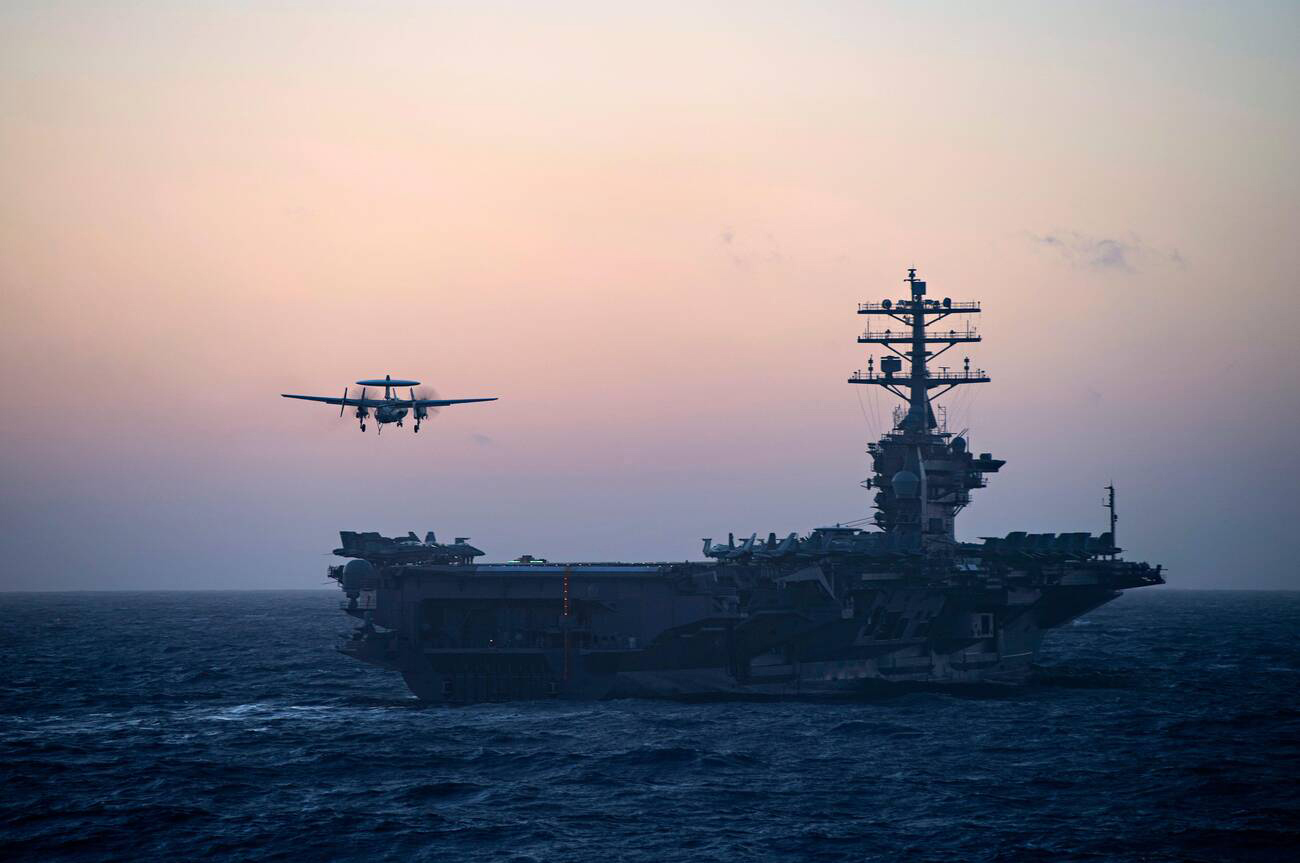
The debate about the sense and nonsense of procuring, equipping and continuously modernizing so-called legacy systems in the armed forces has reached the security policy mainstream. Inexpensive effectors and powerful sensors, some of which are commercially available, are fueling expectations that expensively developed, complexly designed and manned military platforms could lose relevance.
On the ground, the acquisition of armored combat vehicles is the subject of controversial debate against the backdrop of drone-saturated battlefields. At sea, the Houthis’ interdiction activities also show that land-based strike complexes require much more elaborate protective measures for maritime units.
The debate is particularly heated when it comes to the aircraft carrier – not least because of its largely unchallenged role as a central capital ship since the 1940s.
Against this background, the question arises: is the aircraft carrier an overpriced relic of past wars or does it remain an indispensable instrument of strategic deterrence and global power projection?

Despite this long period of dominance, the aircraft carrier is not a static system. If we take a look at the flying formation, it becomes clear that the carrier has developed numerous forms over the decades. This is particularly evident in the US Navywhich has the largest number of carriers and thus the richest wealth of experience. For example, the ratio of fighter to attack aircraft varied considerably until the multi-role aircraft of the F/A-18 family dominated the flight deck. In turn, the Soviet combination of supersonic bombers and precision sea-targeting missiles prompted the US Navy to increase the proportion of heavy interceptors such as the F-14 to protect carriers and the fleet.
The harmonization of the air component by the F/A-18 and F-35, which has been promoted since the 1980s, should therefore not obscure the fact that the carrier was historically an adaptable toolbox. A comprehensive view must also take into account the entire operational unit in order to capture the offensive and defensive division of labor.
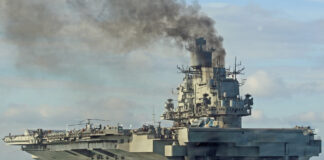
This variance is also evident at the level of the ship type itself: Aircraft carriers do not form a uniform class, but have specialized. Nuclear propulsion and catapults give large carriers enormous operational range and autonomy as well as the ability to launch heavy aircraft.
This gave rise to the US Navy’s “supercarriers”. Smaller ships with shorter flight decks, on the other hand, operate with vertical and short take-off and thus gain flexibility – albeit at the expense of range and payload. In the US context, they are primarily perceived as coastal platforms for presence and power projection, mostly operated by the Marines.
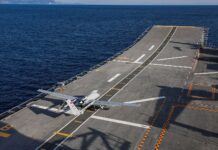
The proliferation of drone technology does not necessarily mean the obsolescence of this classification. For example, the Turkish drone carrier “TCG Anadolu” and the Chinese Yulan class are primarily representatives of the second, “amphibious” category.
Militär Aktuell an Bord des türkischen Drohnenträgers „TCG Anadolu“
Increasing autonomy parameters and payloads that can be launched vertically mean that unmanned systems will be used along the entire established value chain. More disruptive potential probably lies outside established forms of use and configurations. The ability to launch drones from civilian ships and the miniaturization of components that also allow cruise missiles to be containerized indicate that the ability to launch not only missiles but also drones from the sea will tend to increase.
Like manned systems, these drones will also be subject to limitations and developmental trade-offs, for example in terms of payload and range, all-weather flight capability and integration into communication and target engagement networks. However, the basic ability to deploy sensor and strike systems at sea and project power should indeed be proliferating.
The question will therefore not be whether aircraft carriers will disappear, but which form of maritime air power will prevail in the competition between precision effectors, unmanned systems and efficient power projection – and how flexibly existing carrier concepts can respond to this.