Drones are cheap, modular and quickly available – air defense is not. Technological change has created an imbalance that cannot be remedied with existing concepts, which is why a new, affordable and pragmatic defense class is needed for drone defense – a gap-fill air defense. A commentary by Moritz Vischer.
The threat from the air is growing – and is no longer based solely on high-tech: the current drone threat is often based on familiar paradigms, but is massively intensified by modern technologies. Additive manufacturing, compact and cost-effective sensors such as MEMS gyroscopes and accelerometers, thermal cameras and powerful rechargeable batteries enable the construction of small, agile and increasingly autonomous systems. Decentralized manufacturing structures, high modularity and the rapid integration of operational experience are leading to a continuous increase in effective and agile drone platforms. Without new approaches to defense, there is a risk of tactical and economic imbalance – to the detriment of the defenders.
Assuming that the basic paradigms of combating airborne targets have not changed, it is now important to combine the three basic functions – search, track and engage – in such a way that they can be performed as efficiently as possible. In view of the high number of potential attackers, saturation resistance at platform level, but also at higher levels, must currently be accorded crucial importance. Paradoxically, it is precisely the specialization and increase in complexity that have been driven forward in recent decades and are now having a counterproductive effect on the available quantities and delivery times of the systems.
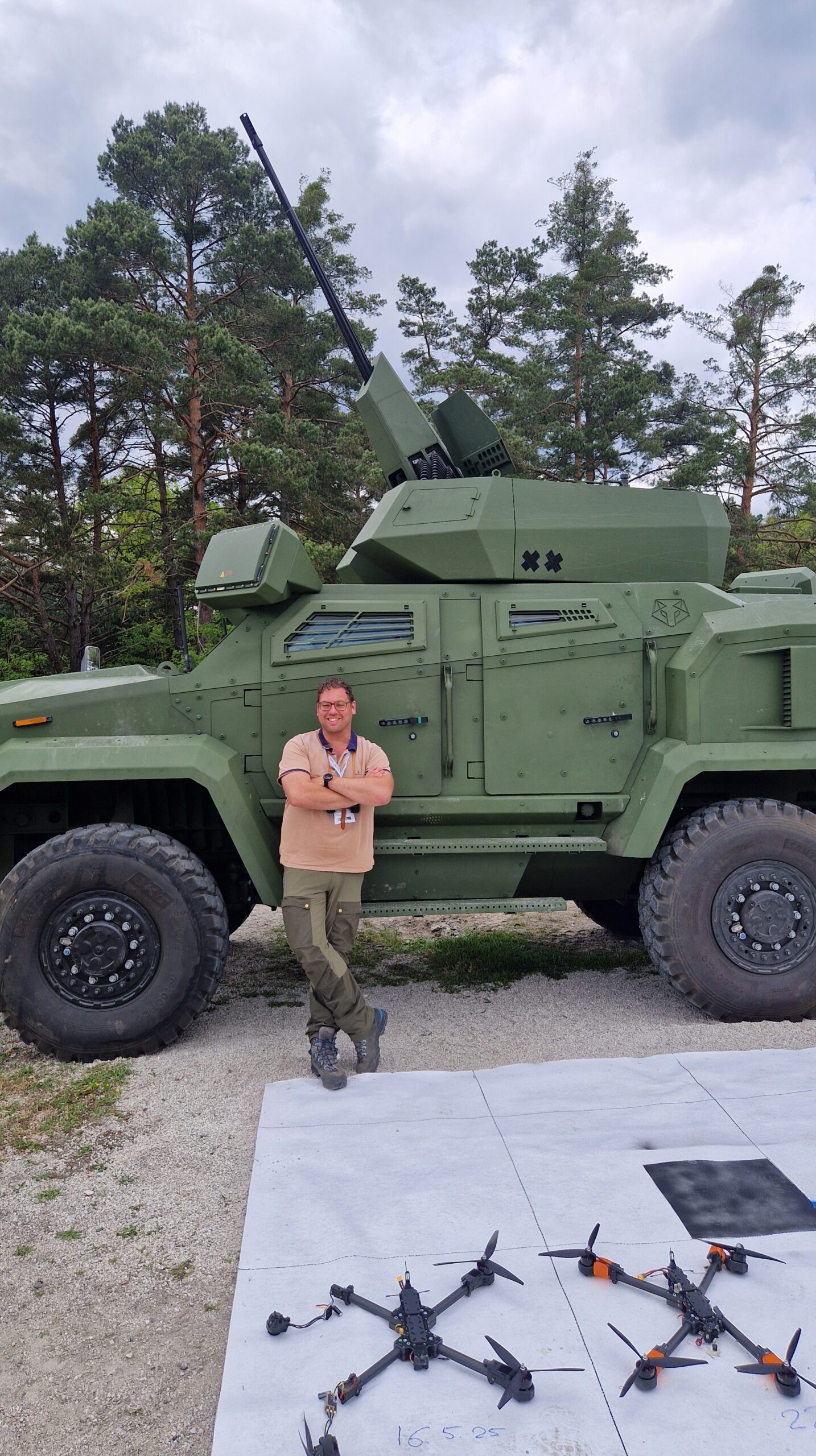
The battle between quality and quantity is never conclusive, but can be narrowed down relatively well, especially in air defense. If the search sensor is unable to locate small targets or if the design of the effector’s hit and destruction probability is not correct, the system performance drops disproportionately. This cut-off effect is particularly evident in the case of tube weapons or jammers.
In principle, the probability of being hit is independent of the caliber. However, the range of small calibers is limited by the sharp drop in velocity and even a very high rate of fire (cadence) quickly fizzles out at short distances due to the dispersion. The use of bullets without self-destruction is also always a safety risk (collateral damage). Only the use of proximity fuzes or speed-fuzed ammunition (in the larger calibers) makes it possible to achieve a sufficiently high density of subprojectiles for the destruction of very small targets and to significantly increase the stopping distance.
 This can be seen in the current success of the 30 mm × 173 caliber and, more recently, the 25 mm × 137 caliber. Other calibers such as the 40 mm grenade launcher ammunition and the 30 mm × 113 caliber have a noticeably lower muzzle velocity, which has a very negative effect, especially with regard to the flab hypothesis. This simple, basic and still valid heuristic of air defense gives an indication of the effective ranges and limits of the use of barrel weapons. This is due to the need to predict the trajectory of the target during the time of flight of the projectile. Jammers are currently reaching the cut-off point through the use of fiber optic-based drone control systems or the increasingly AI-based use of autonomous drones. These developments have caused the manageable effect of external jamming signals to quickly fizzle out.
The consolidation of these thoughts leads to the keywords; affordable, available, adequate. This inevitably leads to the realization that it would be expedient to introduce a new category between the VSHORAD class (colloquially known as air defence) and CAFAD (air defence). This Gap Filler Air Defense category takes into account the lower threshold (cut-off) of the required complexity without this leading to a cost explosion at platform level.
The emerging fluidity of categories, boundaries and definitions that can be observed in society in general had an extraordinarily liberating effect on the development of drones and loitering munitions. It is now appropriate to bring this playfulness and openness to the development of adequate and affordable air defense solutions. It is certainly expedient to carefully introduce not only the developers but also the procurers and users to the advantages and limitations of adequate solutions in the sense of “expectation management”.
As long as user safety is guaranteed, adequate qualification would also be a way of significantly speeding up the development time. Ultimately, the courage to leave gaps is probably the key to closing the current gap in air defense quickly and cost-effectively.
Click here for more news on the subject of drones.